
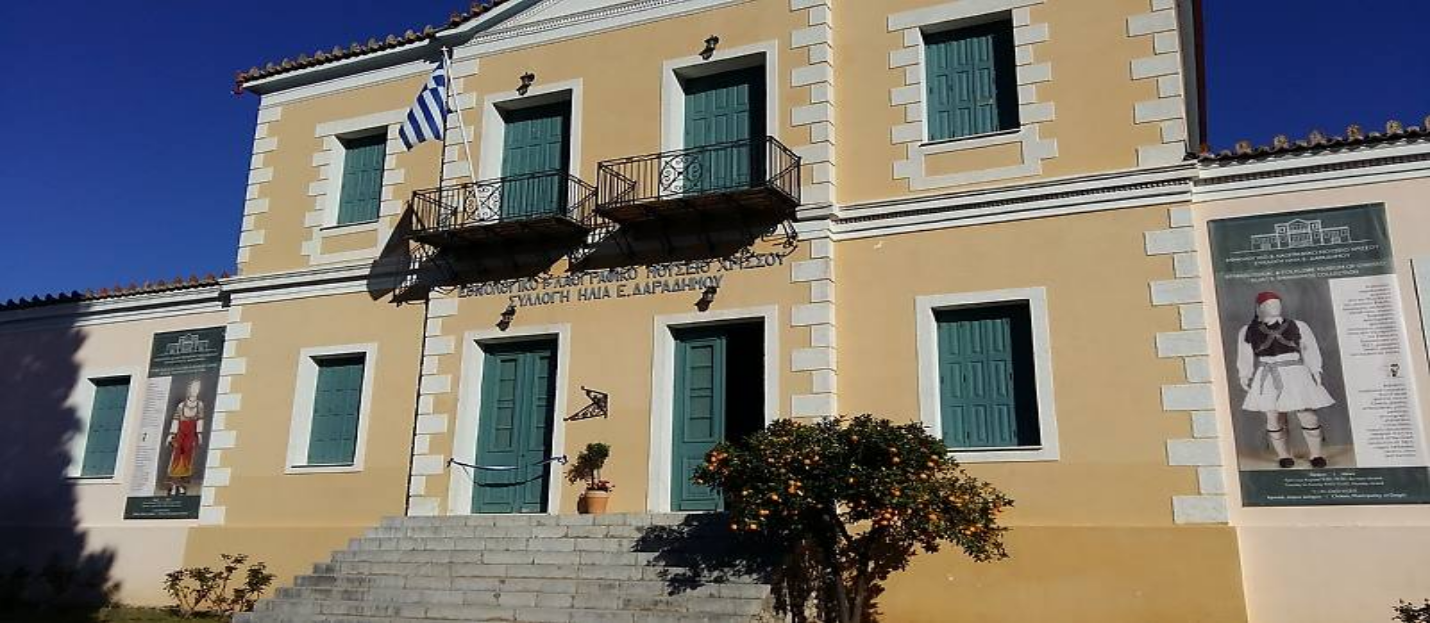
CHRISSO MUSEUM
In Chrisso Fokidas, a historical village characterized as a traditional settlement at the foot of Parnassos, one of the most complete, most valuable and most impressive collections of traditional costumes in Greece is housed in Ethnological and Folklore Museum of Chrisso “Ilias Daradimos Collection”.
The collection of the Ethnological and Folklore Museum of Chrisso is the result of a constant and persistant effort of the last fifty years by the collector Mr. Ilias Daradimos and continues today to be enriched with valuable, interesting and rare objects of folk cultural heritage.
When the size of the collection reached the point that it could be shared with the public, the collector donated it to the Municipality of Delphi in order to be housed and exhibited permanently in the old school of Chrisso, a building of great historical importance. The building was built circa 1890s and is an important monument of the region. Its construction, according to one theory, is attributed to the famous architect of the era Ernest Tsiller, who had designed many other public buildings in Greece. Among his works are the Presidential Palace of the Hellenic Republic, Iliou Melathron, the City Hall of Ermoupolis, the Museum of the Macedonian Struggle of Thessaloniki, etc.
After many years of efforts, the Chrisso Museum opened its doors in December 2015 and since then it has been operating continuously, while in 2017 it received an honorary distinction from the Ministry of Culture.
The foundation of this collection is a series of about 200 Greek traditional costumes which are placed chronologically on the pre-revolutionary, revolutionary, reign of king Otto, and beyond era, until almost 1920, when they were gradually out of use due to the prevalence of European fashion in Greece.
These costumes are considered unique in variety, quality and performance of stitching, colour schemes and originality of designs. Apart from the region of Fokida, the collection includes traditional costumes from throughout Greece, so that the visitor has the opportunity to study and identify similarities and differences.
Apart from the area of Fokida, the collection also includes traditional costumes from all over Greece, and visitors have the opportunity to study them and to identify similarities and differences.
The collection of traditional costumes is complemented by rare prints, paintings, philhellenic collectibles, ceramic items, copper tableware, furniture, photographs, historic documents, traditional jewellery, and embroideries and weapons from the period of the Greek Revolution of 1821. As of today, a total of more than [800] items are being exhibited at the Museum.


